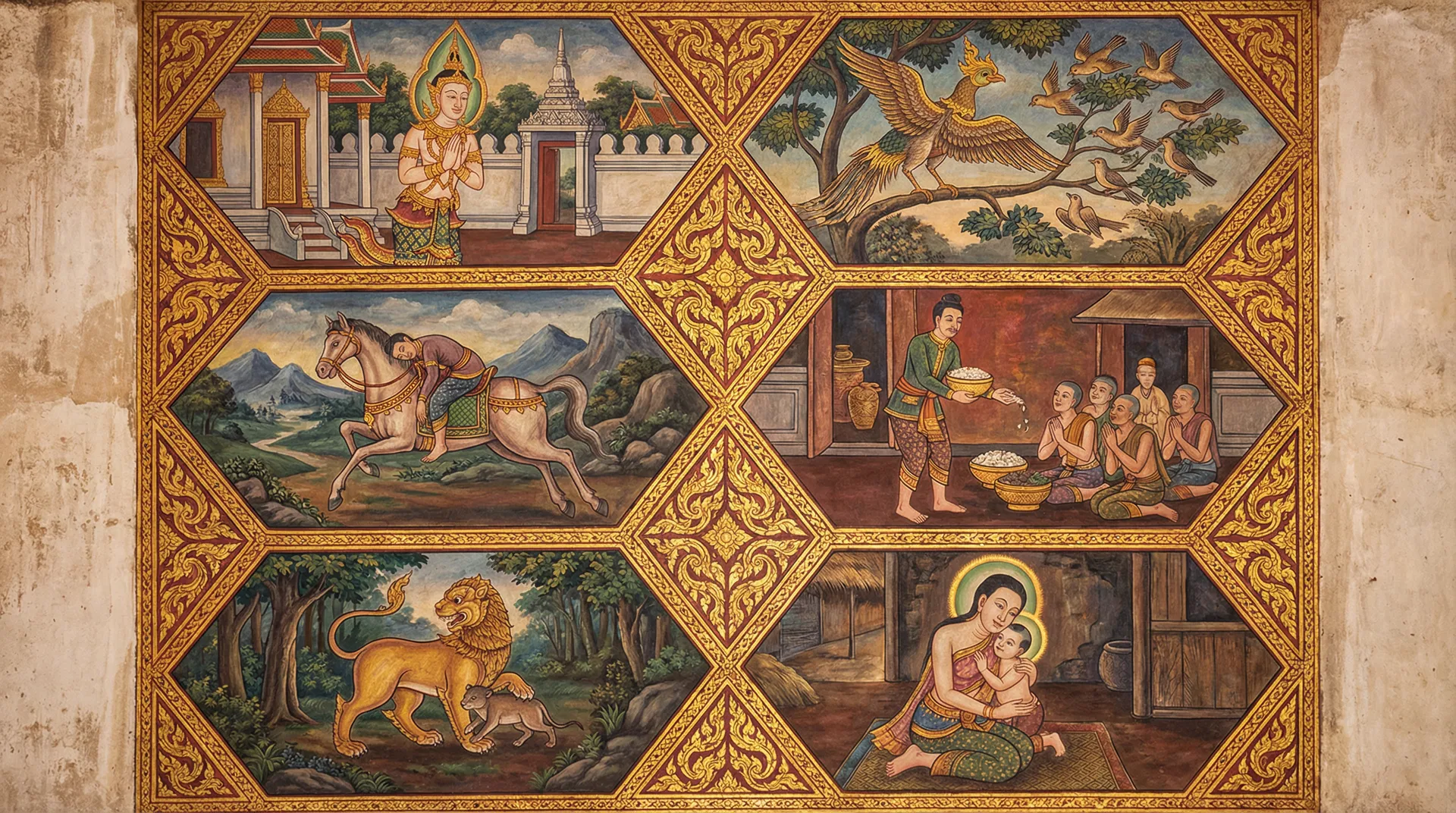
Mahā-bodhijātaka
Mahā-bodhijātaka
In the celestial realm, where clouds of pure light drifted and music of the spheres played eternally, lived a being of immense merit and wisdom. This being, destined to become the great Bodhisattva, often observed the mortal world with compassion. On this particular occasion, his attention was drawn to a bustling city named Jetuttara, ruled by a king renowned for his wealth and his discerning taste for the finest things.
King Jetuttara possessed a magnificent garden, renowned throughout the land for its exotic flowers, its rare trees, and its fragrant herbs. At the heart of this garden stood a towering, ancient mango tree, laden with the most succulent and aromatic mangoes anyone had ever tasted. These were not ordinary mangoes; they were said to possess a sweetness that could charm the senses and a fragrance that could lift the spirits. The king cherished this tree above all else, and its fruits were reserved solely for his royal palate.
One day, a wise hermit, his hair long and white, his robes simple and worn, arrived at the city gates seeking alms. He had traveled far, his spirit pure, his mind seeking only spiritual enlightenment. He had heard tales of King Jetuttara's generosity and the beauty of his garden, but his true desire was not for earthly riches, but for a moment of peace and perhaps a taste of something that embodied nature's purest sweetness, to inspire his meditations.
The king, upon hearing of the hermit's arrival, felt a pang of pride. He wanted to impress the holy man with his wealth and the splendor of his kingdom. He summoned the hermit to his court.
"Venerable sir," the king declared, his voice booming, "I am King Jetuttara, ruler of this prosperous land. You have come seeking alms, and I shall grant them generously. What is it that you desire most? Gold? Jewels? Fine silks?"
The hermit, with a gentle smile, replied, "Your Majesty, I seek no earthly treasures. My journey has been long, and my spirit longs for nourishment. I have heard of the exquisite mangoes that grow in your royal garden, fruits said to be the sweetest in all the land. If it pleases Your Majesty, a single mango from that celebrated tree would be a gift that would truly sustain my spirit."
The king's pride swelled. He saw this as an opportunity to showcase his magnificent garden. "Of course, venerable hermit!" he exclaimed. "My garden is yours to behold, and its fruits are yours to savor. I shall have the finest mango from my special tree brought to you immediately!"
However, the king had a flaw: he was possessive. He loved his possessions, and the thought of parting with even a single fruit from his most prized tree, though he had promised it, brought a flicker of reluctance. He instructed his gardener, a man named Sura, to select the most perfect mango. "Sura," he commanded, "take this hermit to the great mango tree. Select the finest, most radiant fruit, the one that embodies all the sweetness and fragrance of the tree. Bring it to me, and I shall present it to the hermit."
Sura, a loyal but somewhat cunning man, led the hermit to the garden. He gazed at the magnificent mango tree, its branches heavy with ripe fruit. He saw many beautiful mangoes, but his mind was already at work. He thought, "If I give the hermit the very best mango, the king will surely be delighted. But then, what will be left for the king? Perhaps I can give him a slightly less perfect one, and present the truly divine fruit to the king myself, claiming it as my own discerning selection."
With this selfish thought, Sura chose a mango that was indeed exceptionally beautiful, its skin glowing with a golden hue and its fragrance filling the air. It was, by any measure, a prize fruit. However, Sura knew that a few other mangoes on the tree were even more exquisite, holding a deeper sweetness and a more intoxicating aroma.
He presented the chosen mango to the hermit, who accepted it with deep gratitude. The hermit, though he sensed a slight lack of true perfection in the fruit, was too polite and too focused on his spiritual journey to voice any complaint. He thanked Sura profusely and left the garden, eager to savor the fruit in solitude.
Meanwhile, Sura, driven by greed, returned to the king. He presented another mango, one that he believed was slightly superior, and declared, "Your Majesty, I have brought you the most perfect mango from your celebrated tree. Its sweetness is unparalleled, its fragrance divine!"
The king, his heart filled with anticipation, took a bite. His eyes widened. It was indeed a fruit of extraordinary quality, the taste a burst of pure bliss. He was overjoyed. "Sura, you have served me well! This is truly the finest mango I have ever tasted!"
Later that day, the hermit found a quiet spot and prepared to eat his mango. He closed his eyes, took a bite, and found it to be very sweet, very fragrant, and quite satisfying. He offered his gratitude to the universe and to the king. However, in his heart, he knew that there was a subtle difference, a hint of something even more sublime that he had not experienced.
The Bodhisattva, observing this from the celestial realm, saw the king's possessiveness and Sura's deceit. He knew that true generosity is not just about giving, but about giving with a pure heart, without expectation or reservation. He saw how Sura's greed had tainted the act of giving, and how the king's pride, though seemingly innocent, was also a form of attachment.
The Bodhisattva decided to intervene, not with celestial power, but with a gentle lesson. The next morning, as the king was preparing to enjoy another mango, the Bodhisattva manifested as a wise old crow. The crow flew down and landed near the king's feet.
"Your Majesty," croaked the crow, its voice surprisingly clear, "you enjoy the sweetness of this mango, but do you know the true source of its sweetness?"
The king, surprised by the talking crow, replied, "It is from my magnificent tree, of course."
"Indeed," said the crow. "But the sweetness is amplified when it is given with a pure heart. Your gardener, Sura, gave this fruit to you with a heart clouded by greed, keeping the truly divine fruit from the hermit who sought only spiritual sustenance."
The king was taken aback. He summoned Sura, who, under the crow's piercing gaze, confessed his deception. The king was furious, not just at the dishonesty, but at the thought that his own possessiveness had encouraged such behavior.
The Bodhisattva, in the form of the crow, then spoke again. "True generosity, Your Majesty, is not in hoarding the best for oneself, but in offering the best to others with an open heart. When you truly give without attachment, the sweetness you experience is far greater than any fruit can provide."
The king, humbled by the crow's words and ashamed of his own possessiveness and Sura's deceit, understood. He realized that his attachment to his possessions, and his pride in them, had prevented him from experiencing the highest form of giving.
From that day on, King Jetuttara practiced true generosity. He gave freely, not just of his wealth, but of his heart. He ensured that the hermit received the finest gifts, and he learned to find joy not in possessing the best, but in sharing it. The mango tree continued to bear fruit, but for King Jetuttara, the sweetest fruit was the joy of selfless giving.
— In-Article Ad —
💡Moral of the Story
True generosity lies in giving selflessly, with a pure heart, and without attachment to one's possessions or the outcome. Greed and possessiveness diminish the value of any gift, while selfless giving brings the greatest joy.
Perfection: Generosity
— Ad Space (728x90) —
More Jataka Tales You May Enjoy
 218Dukanipāta
Masa Jataka
Masa JatakaIn a serene monastery nestled amidst rolling hills, lived a devout monk named Bodhisattva...
💡 Attachment to desires and possessions leads to suffering. True contentment comes from inner peace and detachment, not from external things.
389ChakkanipātaMahasutasoma Jataka
Mahasutasoma JatakaIn a distant land, where ancient trees touched the heavens and rivers flowed like...
💡 True power lies in wisdom, compassion, and self-control, not in force or selfish indulgence. Understanding the nature of suffering and craving is the path to liberation.
 31Ekanipāta
The Bodhisatta as a King of Elephants
The Bodhisatta as a King of ElephantsIn the heart of a vast and verdant forest, where ancient trees ...
💡 Wise leadership, determination, and the ability to inspire trust can guide a community through perilous journeys to safety.
168DukanipātaSālūka Jātaka
Sālūka JātakaNestled beside a vast, tranquil lake, where lotus flowers bloomed in vibrant hues and t...
💡 Patience and inner stillness are not weaknesses but strengths. They allow for deeper understanding, greater wisdom, and enduring peace.
159DukanipātaNimi Jataka
Nimi JatakaIn the ancient land of Videha, there ruled a king named Nimi. King Nimi was a paragon of ...
💡 Understanding the law of karma and the consequences of one's actions is essential for cultivating virtue and progressing towards liberation.
76EkanipātaThe Tale of the Fragrant Tree
The Tale of the Fragrant Tree In the heart of a vast and ancient forest, where sunlight dappled thr...
💡 Curiosity, coupled with the courage to learn new things, can lead to great discoveries that benefit society.
— Multiplex Ad —